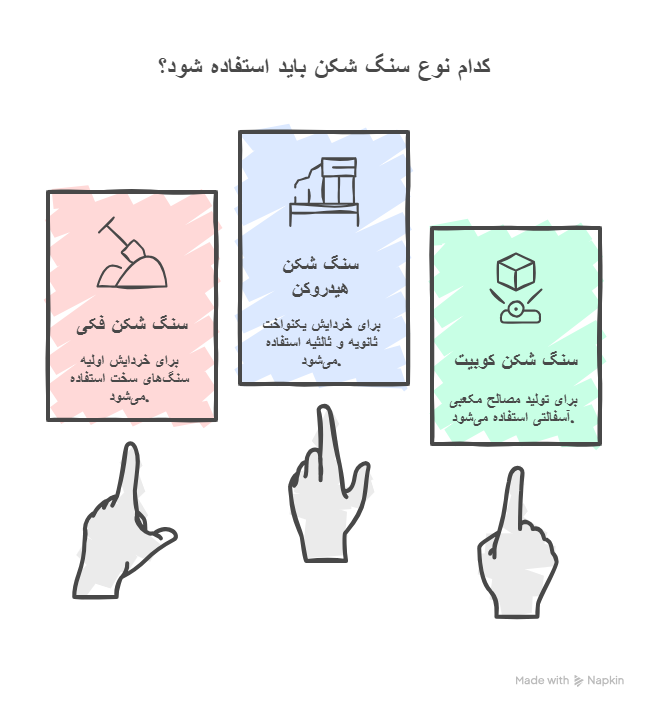
What is the difference between jaw crusher, hydrocone and cube crusher in crushing?
- Jaw crusher for primary crushing of hard rocks
- Hydrocone for uniform secondary and tertiary crushing
- Cubit for producing asphalt cubic materials
Comparison table of jaw crushers with hydrocone and cobite
| Features | jaw crusher | hydrocone crusher | cobite crusher |
| Crushing type | Compression (fixed and movable jaws) | Impact | |
| Stage Crushing | Primary | Secondary and Tertiary | Secondary |
| Maximum input size | 30 to 120 cm | 60 to 300 mm | 100 to 300 mm |
| Output size | 3 to 25 cm | 6 to 40 mm | 0 to 40 mm |
| Production capacity | 20 to 400 tons/hour | 50 to 500 tons/hour | 50 to 300 tons/hour |
| System type | Mechanical | Cone + Hydraulic | Rotor and hammer |
| Suitable Stone Hardness | Very Hard | Hard to Semi-Hard | Soft to Semi-Hard |
| Product Uniformity | Low | High | High (cubic) |
| Amortization Rate | Low | Medium | High |
| Maintenance cost | Low | Medium | High |
| Output adjustment capability | Limited | Precise and hydraulic | Medium |
| Indicative application | Primary crushing of mines | Sand Standard | Asphalt Materials |
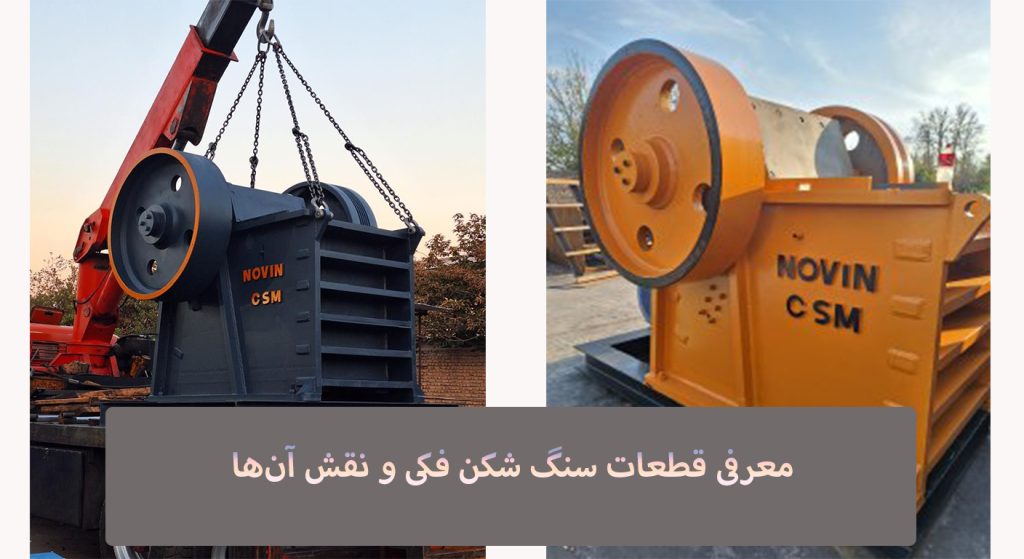
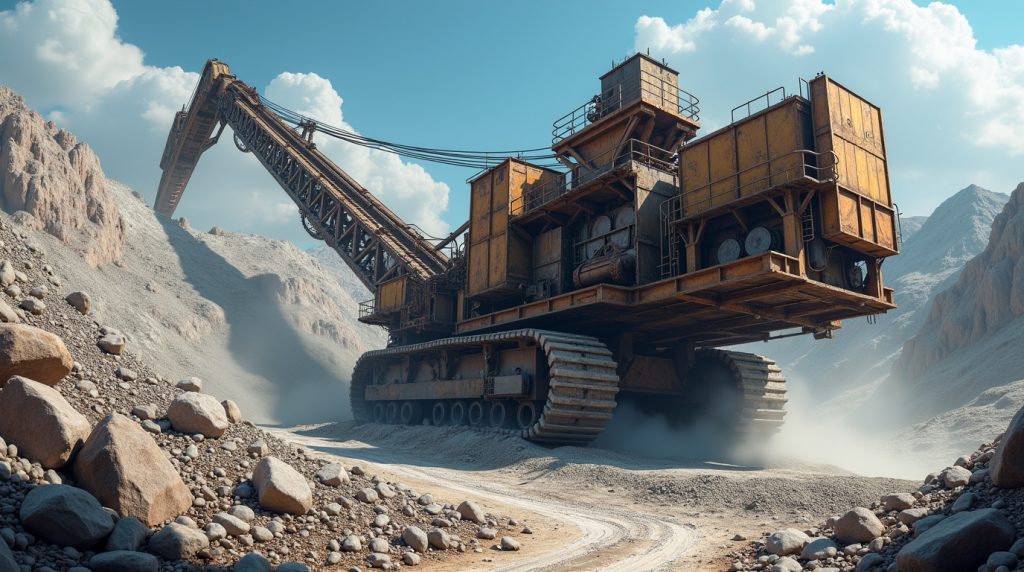
What is a jaw crusher?
A jaw crusher consists of two fixed and movable jaws, between which the stones are placed. The movable jaw, by moving back and forth towards the fixed jaw, puts the stone under intense pressure, and the crushing process is carried out based on the application of mechanical pressure.By reducing the distance between the two jaws, the stones are broken into smaller pieces and exit the outlet of the machine. The jaw crusher is suitable for crushing very hard and resistant stones.Technical specifications of jaw crusher:
- Inlet opening dimensions: 40×60 to 120×150 cm
- Maximum input stone size: 30 to 120 cm
- Production capacity: 20 to 400 tons per hour
- Electromotor power: 15 to 150 kW
- Moving jaw speed: 250 to 350 rpm
- Outlet size: 3 to 25 cm (adjustable)
- Jaw type: single or double-armed
- Jaw material: 12% to 14% manganese steel
- Machine weight: 3 to 100 tons
- Overall dimensions of the machine: 2×3 to 6×8 meters
- Energy consumption: medium to high
- Installation type: fixed or mobile
Applications of Jaw crusher:
- Primary crushing of minerals
- Use in large and open pit mines
- Crushing very hard rocks
- Preparing feed for secondary crushers
- Use in sand and gravel production lines
- Crushing iron, copper, lead and zinc ores
- Use in road construction and civil engineering industries
- Use in mineral processing plants
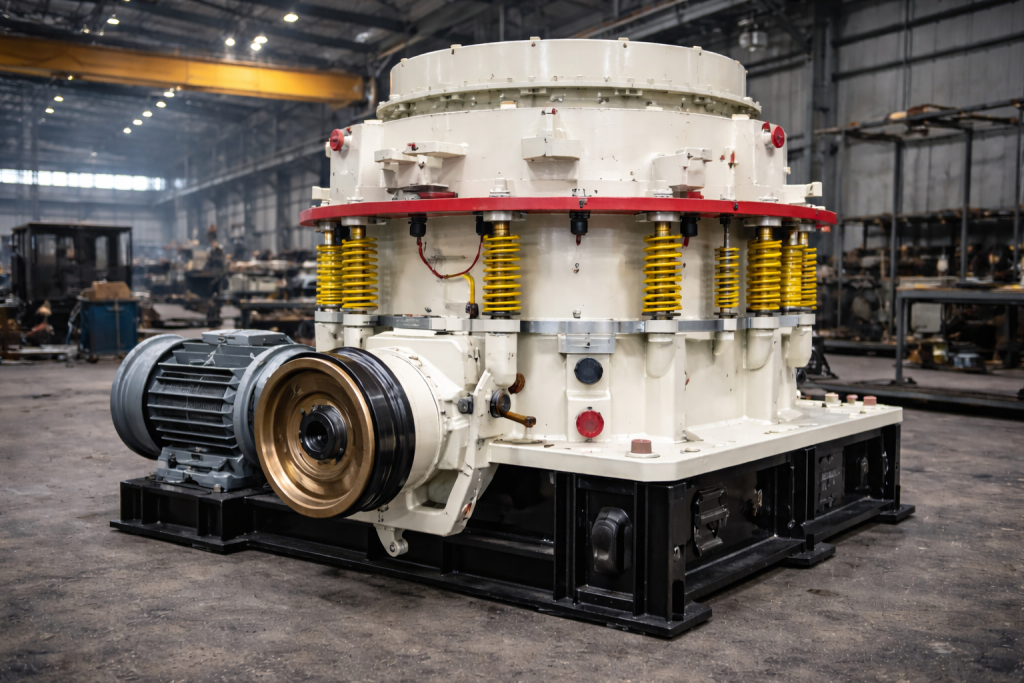
What is a Hydrocone Crusher?
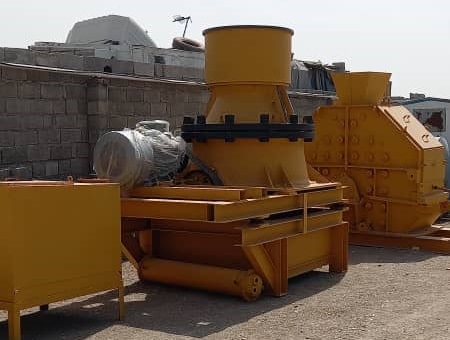
A hydrocone crusher is one of the most widely used cone crushers in crushing lines, usually used in secondary and tertiary stages. With its conical structure and uniform pressure between the mantle and the concave, this device performs the crushing operation in a controlled manner, and the performance of its main components, such as the mantle, concave, head center and bushings, plays a decisive role in the final efficiency of the device, the details of which are given in Comparison of the 4 important parts of a hydrocon crusher is well defined.
The presence of a hydraulic system in a hydrocon crusher It allows for precise adjustment of the outlet opening and, in addition to increasing safety, prevents possible damage caused by the entry of metal parts or non-crushed materials. This capability has made this machine suitable for use in lines where sand and gravel production with precise grain size is important, along with other related equipment. rel=”noopener” data-start=”1134″ data-end=”1382″>Sand making crushers be considered as a safe choice.
Technical specifications of the Hydrocone crusher:
- Device size: 36, 45, 55, 66 inches
- Production capacity: 50 to 500 tons per hour
- Maximum input size: 60 to 300 mm
- Output size: 6 to 40 mm
- Electromotor power: 75 to 250 kW
- Main shaft speed: 300 to 600 rpm
- Mantle and concave material: Wear-resistant manganese steel
- System Opening adjustment: Hydraulic
- Weight of the machine: 10 to 40 tons
- Lubrication type: Automatic
Applications of Hydrocone crusher:
- Secondary crushing of minerals
- Tertiary crushing for precise granulation
- Standard sand and gravel production
- Use in hard and semi-hard rock mines
- Use in mineral processing lines
- Suitable for asphalt and concrete plants
- Use in road construction and civil engineering projects
What is a Cobit crusher?
Cobit crusher is mostly used in the secondary crushing stage This device works on the basis of an impact system and after entering the crushing chamber, the stones are hit by the hammers mounted on the rotor at high speed and crushed against the anvil plates.
The structure of the kubit includes the rotor, hammers, anvils, body and outlet opening adjustment system, which ensures fast crushing and the final product has a suitable and uniform shape.
Technical specifications of Kubit crusher:
- Production capacity: 50 to 300 tons per hour
- Maximum input size: 100 to 300 mm
- Output size: 0 to 40 mm
- Electromotor power: 75 to 200 kW
- Rotor speed: 500 to 1000 rpm
- Number of hammers: 4 to 6
- Material of hammers: Manganese steel or wear-resistant alloy
- Weight of the machine: 5 to 25 tons
- Type of outlet adjustment: mechanical or hydraulic
Crusher applications Cubit:
- Secondary crushing of minerals
- Crushing soft and semi-hard rocks
- Production of asphalt materials
- Use in sand and gravel production lines
- Production of cubic materials
- Use in road construction projects
- Use in concrete and asphalt plants
Advantages and disadvantages of jaw crushers, hydrocone and cobite
| Type of crusher | Advantages | Disadvantages |
| Jaw crusher | High crushing powerSuitable for very hard rocksSimple and durable structureLow wearParts suitable for primary crushing | Coarse outputIrregular granulationRelatively high energy consumptionNot suitable for final stages |
| Hydrocone crusher | Uniform crushingAbility to precisely adjust the outputSuitable for secondary and tertiaryLess wear and tear compared to the KubitStandard sand and gravel production | High initial priceSensitive to the entry of metal partsRequires more specialized maintenance |
| Kubit crusher | High efficiencyProduces cubic materialsSuitable for asphalt and concreteVariety of models and capacitiesRelatively simple output adjustment | High wear and tear of hammersNot suitable for very hard rocksHigh maintenance costHigh wear and tear of parts |
FAQ
How adjustable is the output size of the Hydrocone and Cobit crushers?
The outlet size of the hydrocone is usually between 6 and 40 mm and the cubit is between 0 and 40 mm and can be adjusted with a hydraulic or mechanical system.
For the production of building materials and asphalt, is a Kubit crusher better than a hydrocone or jaw crusher?
For the production of asphalt and concrete materials, the Kubit crusher is the best option, for standard sand and gravel, the Hydrocone crusher is suitable, and the jaw crusher is more suitable for the primary crushing of rocks.
What is the maintenance and depreciation cost of jaw crushers, hydrocones, and kubits?
The jaw crusher has the lowest depreciation and maintenance cost, the hydrocone has the average and the cubit has the highest cost and depreciation due to the use of hammers and impact system.
Does Novin Masesaz provide spare parts and after-sales service for jaw crushers, hydrocones, and cobites?
Yes, in addition to selling machines, Novin Masesaz supplies spare parts and after-sales service for all stone crushers and provides purchasing advice.