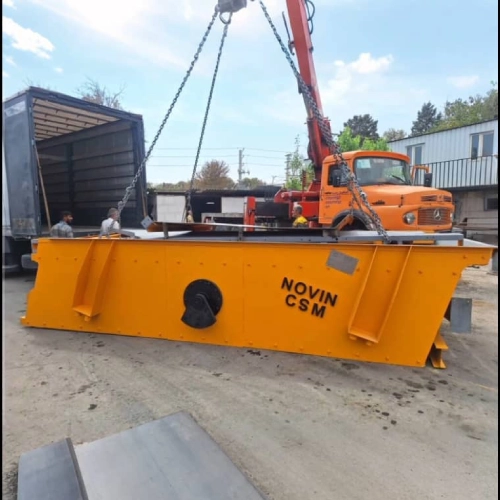
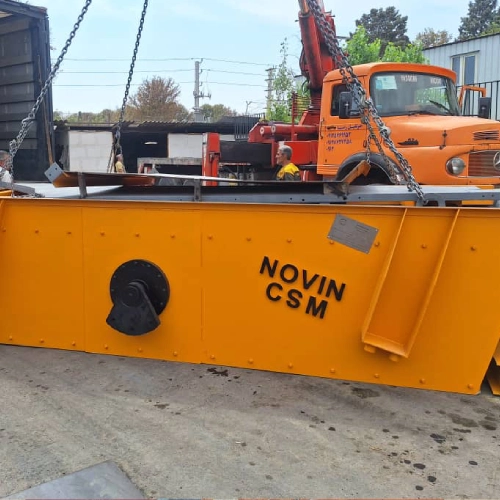
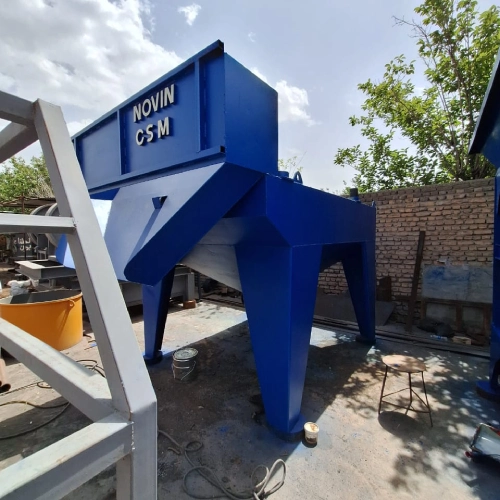
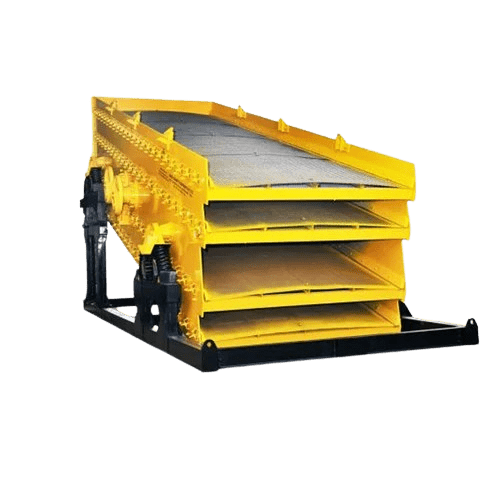
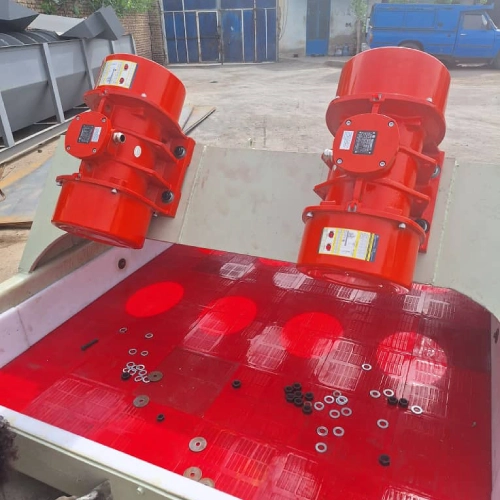
Screens are one of the most widely used equipment in the mining, construction, and sand and gravel production industries. They are also known as industrial screens or stone crusher screens. Depending on the type of application, they are used in mines, sand and gravel production workshops, stone crushing lines, and even the food and chemical industries.
| Sieve type | Dimensions (meters) | Slope of floors | Body material | Lace type | Motor power (kW) | Vibration frequency (Hz) | Vibration amplitude (mm) | Production capacity (ton/hour) | Main application |
|---|---|---|---|---|---|---|---|---|---|
| Screen with Vascasini axis | 1 × 6 × 1.2 | 2–3° | Resistant steel | Steel or polyurethane | 3–5 | 12–15 | 3–5 | 10–15 | Separation of minerals with medium abrasion |
| Two-story screen 1*6_ 6*1 | 1 × 6 × 1.5 | 2–4° | Resistant steel | Steel or polyurethane | 5–7.5 | 12–16 | 3–5 | 15–25 | More accurate grading and separation of materials |
| Three-tier sieve 1*6_ 6*1 | 1 × 6 × 1.8 | 2–4° | Resistant steel | Steel or polyurethane | 7.5–11 | 12–16 | 3–5 | 20–30 | Multi-size grading and separation |
| Drying sieve | 1 × 6 × 1.5 | 1–3° | Resistant steel | Steel or polyurethane | 5–7.5 | 10–14 | 3–4 | 10–20 | Drying sand and reducing moisture before packaging or use |
A screen is a mechanical device that can be used to separate minerals, rocks, sand, or any other type of fine or coarse particles based on size. This process is known as grading or screening and plays a key role in various industries. As such, a screen is not just a simple screening device, but is part of a production line that determines the quality of the final product.
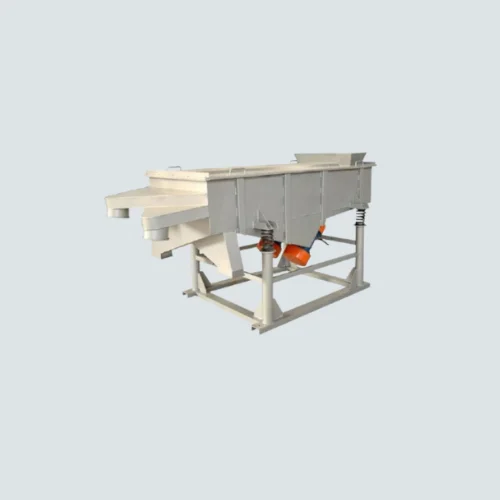
| Sieve type | Main specifications | Approximate engine power | Screen mesh type | Main applications |
|---|---|---|---|---|
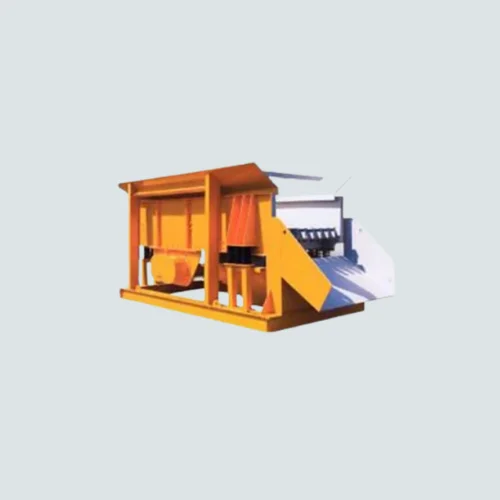
| Industrial sieve | Heavy duty design, high capacity, suitable for large production lines | 11 – 22 kW | Steel / Polyurethane | Mines, chemical industries, large factories |
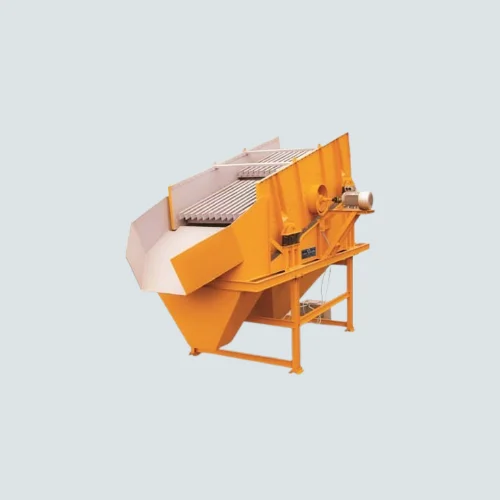
| Sand and gravel sieve | High accuracy in separating fine and coarse particles | 7.5 – 15 kW | Steel | Production of sand, concrete, asphalt |
| Sand washing screen | Comes with a washing system and mud separation | 7.5 – 11 kW | Waterproof polyurethane | Improving the quality of sand used in projects |
| Sand drying screen | Ability to dewater and dry sand, preventing waste | 7.5 – 11 kW | Anti-wear polyurethane | Sand washing plants, mines |
| Granulation sieve | Precise separation in several different sizes (2 to 4 floors) | 7.5 – 15 kW | Steel / Polyurethane | Production of asphalt, concrete and building materials |
| Stone crusher screen | Installation in stone crushing lines, impact resistant | 11 – 22 kW | Steel / Wear-resistant steel | Stone quarries, primary and secondary crushing lines |
The price of a screen depends on the capacity, number of floors, type of machine, and type of screen. The material of the body and chassis, engine power, and manufacturer’s brand also affect the price. Quality screens and reputable brands have a higher price. Energy consumption and maintenance costs also play a role in determining the price.
Purchasing a stone crusher screen is an important decision for any production line, as choosing the right machine directly affects product quality, production capacity, and maintenance costs. To choose the best option, consider the following points:
The screen mesh is one of the most important components of a screening machine and its main function is to separate and grade materials. When materials enter the machine, they pass through the mesh and are separated based on their particle size. This process ensures that the final product is uniform and of high quality and that the machine can operate at its maximum capacity.
The performance of the mesh directly affects the quality of the product and the speed of production. If the mesh is damaged or clogged, particles will not be separated properly, production capacity will decrease and even the quality of the final product may decrease.
| Lace type | material | material | material | material |
|---|---|---|---|---|
| Steel | Resistant steel sheet | Economical, medium wear resistance | Reasonable price, relatively good durability | Medium abrasive minerals |
| Steel | Stainless steel | High rust and abrasion resistance | Long life, corrosion resistant | Corrosive or highly abrasive materials |
| Polyurethane | Industrial polymer | Flexible, reduces clogging, anti-wear | Long life, prevent mesh blockage | Sand, gravel and materials with high moisture content |
| Reinforced industrial steel | Durable steel with anti-wear coating | Reinforced chassis and sheet metal, suitable for large industrial lines | High impact resistance and capacity | Industrial screen, large production lines |
| Lace type | Standard dimensions (centimeters) | Wire thickness (mm) | Approximate price (Toman) | Main application |
|---|---|---|---|---|
| Steel mesh | 100×150، 100×200، 120×240 | 3 to 6 | 49,000 – 55,000 | Separation of minerals with medium abrasion |
| Stainless steel mesh | 100×150، 100×200، 120×240 | 2 to 5 | 100,000 – 150,000 | Corrosive or highly abrasive materials |
| Polyurethane lace | 100×150، 100×200، 120×240 | 4 to 8 | 120,000 – 180,000 | Sand, gravel and materials with high moisture content |
There are many sellers and manufacturers in the Iranian market that offer screen mesh, but the fact is that not all of them are reliable. Many stores offer their products without the necessary standards or with low quality, and the customer may encounter problems such as short lifespan, low resistance, and lack of support when purchasing. However, Novin Masesaz, with its special experience and expertise in the field of stone crusher equipment and screen mesh, has chosen a different way to sell screens:
So by choosing Novin Masesaz, you will no longer need to worry about quality, longevity, or after-sales service, and you can ensure the productivity and quality of your production line with a safe and guaranteed purchase.
| Section | Key points | Practical guide | Frequency or timing |
|---|---|---|---|
| Cleaning the net | Tearing, breaking, hole deformation, clogging | Checking the appearance of the mesh and the thickness of the wires | Once a week (small sieve) / after each shift (industrial sieve) |
| Periodic inspection of the lace | Excess particles, mud, clogging | Use a soft brush or appropriate water pressure; avoid sharp tools. | After each work shift or heavy use |
| Maintaining the lifespan of the lace | Thickness reduction, abrasion, processing materials | Customized maintenance program based on lace material and material type | Continuously; check lifespan: steel 6–12 months, stainless steel 2–5 years, polyurethane 3–4 years |
| Replacing the lace | Deformed holes, damaged parts | Installing a new, properly aligned and sturdy grille | As soon as you notice damage or severe wear |
| Operator’s daily checklist | Tear, breakage, cleanliness, alignment | Quick review and recording in the maintenance logbook | Daily, before starting work |
There are many sellers and manufacturers in the Iranian market that offer screen mesh, but the fact is that not all of them are reliable. Many stores offer their products without the necessary standards or with low quality, and the customer may encounter problems such as short lifespan, low resistance, and lack of support when purchasing. However, Novin Masesaz, with its special experience and expertise in the field of stone crusher equipment and screen mesh, has chosen a different way to sell screens:
So by choosing Novin Masesaz, you will no longer need to worry about quality, longevity, or after-sales service, and you can ensure the productivity and quality of your production line with a safe and guaranteed purchase.
A screen is a device used to separate and classify materials based on particle size and is used in the mining and construction industries.
In addition to separation, a sand washing screen cleans and washes the material, while a grading screen merely classifies particles by size.
For sand, polyurethane or steel mesh is usually used, which has high resistance and prevents clogging.
In addition to grading, the Dewatering Screen is also responsible for separating excess water from sand and fine-grained materials.
However, a conventional screen only separates and separates grains based on size.
Typically no. The screen is designed to separate material smaller than the mesh size, and the larger stones are pushed forward over the mesh and do not pass through.

اگر دنبال خرید با چک هستی
همین الان تماس بگیر