| Feature | Description |
| Engine power | 25-60 tons per hour (V8 model: 25-35 tons; V10: 35-60 tons) with 0-6 mm output and 80-90% cubic shape |
| Engine power | 90-200 kW (3-phase, 750-1000 rpm); V8 model: 90 kW; V10: 132-200 kW |
| Rotor speed | 1000-2000 rpm (adjustable to control output size) |
| Rotor and impeller material | High Manganese Steel (SAE 8620) with heat treatment |
| Blade and nail | Tungsten carbide or diamond (Rockwell C hardness 58-62); 12-15 nails |
| Liner | Ni-Hard cast iron with a hardness of HB 200-550 |
| Approximate weight | 8-12 tons (V10: 10 tons; V8: 7-8 tons) |
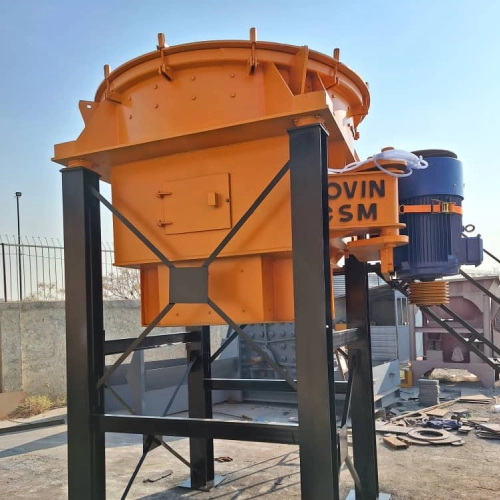
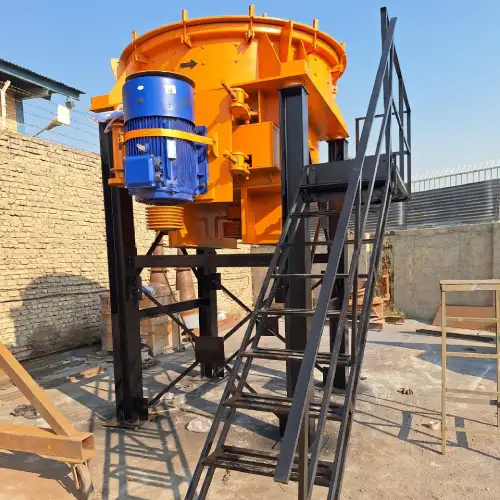
| Dimensions | Length 3-4 meters, width 2-2.5 meters, height 3-3.5 meters (V10 model) |
Initial consultation and information exchange
Initial consultation and information exchange
Place an order
Product loading and shipping
Characteristic | Description |
Product name | Compatible with secondary lines of Cobit/Hydrocon, inlet <40 mm, outlet 0-6 mm |
Origin and manufacturer | Compatible with secondary lines of Cobit/Hydrocon, inlet <40 mm, outlet 0-6 mm |
Material and alloy | Rotor/Impeller: High Manganese Steel (SAE 8620); Blade/Nail: Tungsten Carbide or Diamond; Liner: Ni-Hard Cast Iron |
Difficulty | HB 200-550 (liner/blade); Rockwell C 58-62 (tungsten) |
Operating temperature | Max. 100-150°C (resistant to centrifugal friction heat; suitable for dry/humid environments) |
Standard dimensions | V10 model: length 3-4 meters; width 2-2.5 meters; height 3-3.5 meters; rotor diameter 1-1.2 meters (smaller V8) |
Approximate weight | 8-12 tons (V10: 10 tons; V8: 7-8 tons) |
Production capacity | 25-60 tons/hour (V8: 25-35; V10: 35-60; 0-6 mm output with 80-90% cubic) |
Engine power | 200-90 kW (V8: 90 kW; V10: 200-132 kW; 3-phase, 750-1000 rpm) |
Rotor speed | 1000-2000 rpm (adjustable to control output size; vertical centrifuge) |
Surface and tolerance | Surface finish: Ra 1.6-3.2 μm (rotor); Dimensional tolerance: ±0.03 mm; Blade clearance: 0.5-1 mm |
Abrasion resistance | High (30% longer life with tungsten; self-sharpening, low friction, suitable for hard rocks Mohs 7-9) |
Thermal resistance | Excellent; no deformation at 150°C (air-cooled rotor) |
Processing type | Casting/welding (manganese ingot rotor) + quenching; 12-15 diamond nails; manual/automatic speed adjustment |
Main: Secondary crushing to produce crushed sand (0-6 mm) with cubic shape, suitable for concrete/asphalt (80% ideal output).
Industries: Stone quarries (granite, barite), sand/gravel production, cement, road construction (crushing 6-30 mm to <6 mm).
Types: V8 (low capacity), V10 (medium-high), V10H (heavy duty).
Installation: on concrete base, connection to feeder/screen; leveling ±0.05 mm (1 day with crane).
Maintenance: blade/liner inspection (every 200 hours), rotor lubrication; replacement of nails >5 mm wear. Avoid sticky materials.
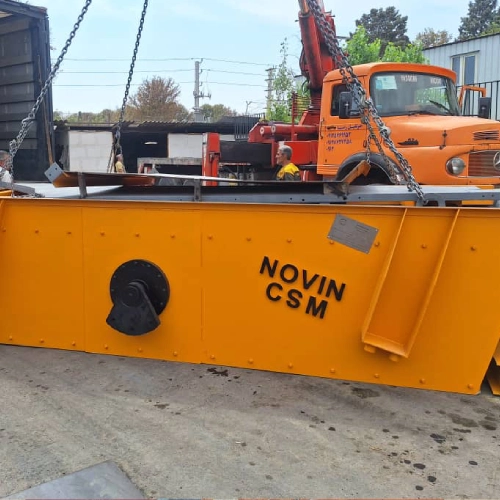
Transportation: maximum 15 tons for trailer (1 unit), 10-ton crane.
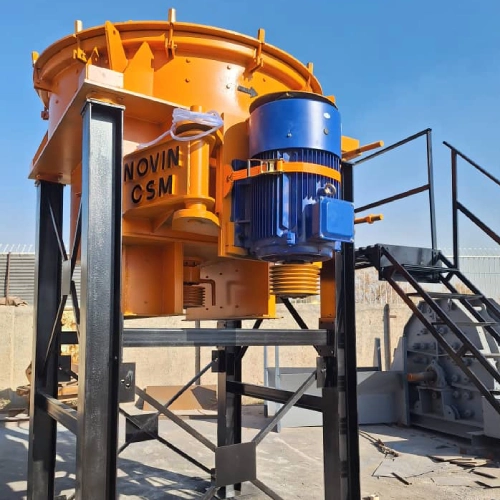
In the Rock-on-Rock model, the rock only hits the rock and there is no metal in the path of the rock. This results in much less wear and tear and the final sand shape is more cubic and uniform. The Anvil model (rock-on-iron) has a higher capacity but more wear.
V8 model: 25-35 tons per hour V10 model: 35-60 tons per hour (with a maximum inlet of 40 mm and an outlet of 0-6 mm, 80-90% cubic)
Suitable for hard and semi-hard rocks such as basalt, granite, diabase, quartz, silica, dolomite and even river rock (Mohs hardness up to 9).
The V8 model is about 90-110 kW and the V10 model is about 132-200 kW/h (depending on the hardness of the rock and settings).
اگر دنبال خرید با چک هستی
همین الان تماس بگیر

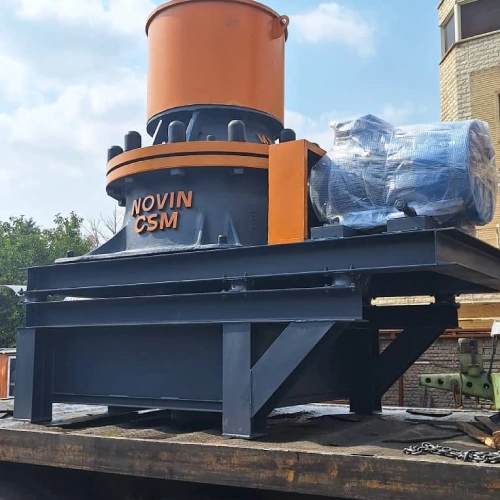
2 reviews for Rock on rock vsi Crusher
amiri –
One of the reasons we bought from this company was the warranty. We had a small problem after installation, but support came and fixed it very quickly.
admin –
Thank you so much for sharing your experience with us.
Real feedback like this really helps others make more informed decisions.
We sincerely thank you for your support and trust 🙏✨
Hosseini –
What is the difference between Rock and Rock and regular sand makers? Is its output different?
admin –
Yes, absolutely. Rock and Rock produces sand by colliding rocks, which results in more uniform output sand, fewer sharp corners, and better concrete quality. It is especially great for producing standard B and C sand.